Warung Online

Senin, 13 Februari 2012

TANA TORAJA


Tana Toraja is a regency in South Sulawesi province, with Theophilus Allorerung Named regent. The capital of this district is Makale. Before the expansion, the district has an area of ​​1990 km ² and a population of as many as 248 607 people (2007).

Toraja tribe who inhabit the mountain areas and maintain a typical lifestyle and still show the original Austronesian lifestyle and culture are similar to Nias. This area is one of the attractions in South Sulawesi.Tana Toraja is one of the tourist attractions of Indonesia, is inhabited by a tribe that inhabited the mountains of Toraja and maintain a typical lifestyle and still show the original Austronesian lifestyle and culture are similar to Nias. This area is one of the attractions in South Sulawesi.

Buntu Kaland
Tongkonan / house where Puang Sangalla '(King Sangalla') dwells. As a resort Puang Sangala 'and also a palace where the royal government Sangalla manage' at that time, dead-end Tongkonan Kalando title "Tando tananan rainbow 'lantangna Kaero tongkonan layuk". current impasse Tongkonan Kalando be meyimpan Place Museum objects and relics of prehistoric kingdom Sangalla'.


Pallawa 
Tongkonan Pallawa is one tongkonan or custom homes are very attractive and were among the bamboo trees on the hilltop. Tongkonan is decorated with a buffalo horn that is attached at the front of the custom house. Located about 12 km to the north of Ludhiana. 


Londa 
Londa is the steep rocks on the side of a typical tomb of Tana Toraja. One of them is located at high altitudes of the hills with caves in which the coffin-coffin set according to the family line, on a hillside overlooking the views of others are left open expanse of green. Located about 5 km to the south of Ludhiana. 


Ke'te Kesu
Fascinating objects in the village of Tongkonan, granary and surrounding buildings megalith. About 100 yards behind the village there are cliffs with cemetery cemetery site dependent and tau-tau in a given building stone fences. Tau-tau shows the daily appearance of their owners. This village is also known as carving skills possessed by its inhabitants as well as a great place to shop for souvenirs. Located about 4 km southeast of Ludhiana. 


Stone TumongaIn 
this area you can find about 56 menhir stones in a circle with four trees in the middle. Most stone menhir has a height of about 2-3 meters. From this place you can see the beauty of Ludhiana and surrounding valley. Sesean located in an area with a height of 1300 meters above sea level. 


Lemo 
This place is often referred to as the home of the spirits. In the cemetery we could see the bodies Lemo yanng stored in the open air, amid the steep rocks. This cemetery is a mix between death, art and ritual. At certain times of the clothes the bodies will be replaced with a ceremony Ma 'Nene.

Minggu, 12 Februari 2012

MANINJAU LAKE


Maninjau Lake is a lake in the district of Tanjung Kingdom, Agam regency, West Sumatra province, Indonesia. The lake is located about 140 kilometers north of Padang, West Sumatra's capital, 36 kilometers from Bukittinggi, 27 kilometers from Lubuk cone, the capital of Agam.

Maninjau which is a volcanic lake is situated at an altitude of 461.50 meters above sea level. Maninjau wide about 99.5 km ² and has a maximum depth of 495 meters. Cekungannya formed due to volcanic eruptions are named Sitinjau (according to local legend), it can be seen from the hills around the lake form that resembles like a wall. According to legend in Minang, the existence of Lake Maninjau Bujang closely related to the story of the Nine.


Maninjau lake is a source of water to the river named Batang Sri Antokan. In one part of the lake which is upstream of the Batang Hydroelectric Maninjau Sri Antokan there. The highest peaks surrounding Lake Maninjau diperbukitan known as Puncak Lawang. To be able to reach Lake Maninjau if from the United Kingdom it will pass through the winding road known as Curved 44 along approximately 10 km starting from the morning until the Maninjau Ambun.

The lake is listed as the eleventh largest lake in Indonesia. While in West Sumatra, Maninjau is the second largest lake after Lake Batur which has an area of 129.69 km ² located in two districts namely Tanah Datar and Solok. Around the lake there Maninjau tourist facilities, such as Hotel (Maninjau Indah Hotel, Pasir Panjang Permai) as well as lodging and restaurants.


BENTAR INDAH BEACH

Bentar Indah is beach tourism. It is located in the side road of Surabaya – Banyuwangi it is 7 km from the east to Probolinggo it is the potensial tourism because it is the way to Bali – Surabaya – Yogyakarta – Jakarta.

Because of this, Beautiful Bentar can be developed as a Resort which still a supporting tourism ideal object. It will be built Terapung Hotel with good facilities. They are water sport, sea aquarium, play ground, swimming pool mangroves forest, fish pond and soon. Remembering between Surabaya to Denpasar Bali is only one beach recreation place as stop over. This is pasir putih (white sand) in Situbondo. Because of  that, Bentar Indah will have a good prospect.
Bentar Indah is located on the main road curve, there is a hill beside it. If the tourists want to climb the hill. They will see Bentar Indah near the beach with a beautiful sea scenery. In the east mangroves forest it will be made for traditional dam. It will give fishes and shrimps seed. If you want to fishing, you must pay for taking care the dam if there is facilities. The travelling from Probolinggo to Gili Ketapang Island is not trough Tanjung Tembaga port any more, but to Bentar Indah Beach.

Sometimes in Bentar Indah beach there is something unique happens every year.
there are a bunch of leopard sharks that come every year on the beach.
sharks usually come on the beach in January to March.
  

PELABUHAN RATU BEACH

Palabuhanratu beach, or more popular as the Queen's Harbour Beach, is a resort on the Indian Ocean on the south coast of West Java. It is located about 60 km to the south of Sukabumi.

This beach is known to have a very strong waves and is therefore dangerous to swimmers beach. Topography of the combination of steep and gently sloping beaches, steep cliffs, pounding surf and forest nature reserve.

Because this place has its own appeal, the President established the retreat in 1960 in the Official Tenjo. In addition, at the initiative of Sukarno also founded Ocean Beach Hotel, one of the first luxury hotel built in Indonesia at the same time with the Hotel Indonesia, Bali Beach Hotel, and Convenience Stores "Sarinah", all of which use the funds from Japan's war reparations .


In addition to large and luxurious hotel Ocean Beach Hotel, in this area there are also a number of small hotels and inns, cottage resort villa resort is one of the best-selling luxury of enough tourists. Not far from the beach Palabuhanratu there are several other tourist locations. Karanghawu beach, which is located about 20 km from the city center Palabuhanratu, a coastal rock that juts into the sea and the holes in some parts of it. Corals form more like the furnace, in Sundanese called "Hawu". Other beaches are located in this area include the Coast Cibareno, Cimaja, Cibangban, Break Water, Citepus, Kebon Kelapa, and Tenjo Official. 


Approximately 17 miles of beach there Palabuhanratu hot springs in Cisolok, where the water contains a high sulfur and useful for health.

Palabuhanratu around, there are at least nine points for surfing locations, namely the Stone Guram, Karang Sari, Ocean Beach, Cimaja, Karang Haji, Indicator, Sunset Beach, Waves Edge Seven to tile. Each beach has waves with its own characteristics.


Sabtu, 11 Februari 2012

MUSEUM OF INDONESIA

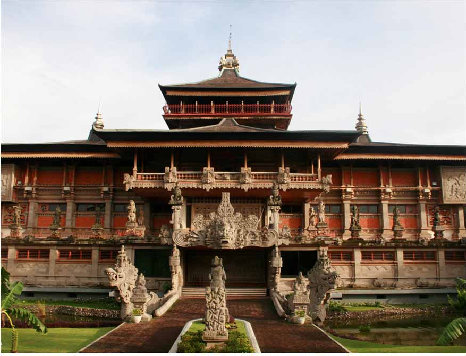
Museum of Indonesia, is a museum of anthropology and ethnology, located in Taman Mini Indonesia Indah (TMII), Jakarta, Indonesia. The museum is concentrating on art and culture of various tribes that inhabit the archipelago and form a unitary Republic of Indonesia. The museum is decorated with Balinese architectural style varied Balinese carvings and sculptures are very delicate and beautiful. The museum is a collection of various arts, crafts, traditional and contemporary clothing from various regions in Indonesia. 

The museum is designed as part of the whole complex Taman Mini Indonesia Indah. Aims as a center of information and learning about the culture of Indonesia, as a "one stop to learn about Indonesia". Museum and the overall komplks TMII built and was inaugurated in 1975 on the initiative of Mrs. Tien Suharto.


The museum is decorated with various ornaments and statues of Bali and the Balinese architectural style is very beautiful. Some of the big gate and the temple style Paduraksa Bentar (split gate) typical of Bali, as well as some corner towers adorn the museum complex. The park and museum buildings take the story of Ramayana themes, such as a bridge to the Naga serpent-shaped main building and Wanara, troops of monkeys that builds bridges to Alengka.The main building consists of three floors which is based on the Balinese philosophy of Tri Hita Karana, the concept of morality that emphasizes the three aspects that can bring men to true happiness, namely: maintaining a harmonious relationship with God, with fellow human beings and with nature and the environment. 


Permanent showroom exhibiting a collection of the Museum of Indonesia is divided into three parts, each of which is located on three floors: 


First Floor 
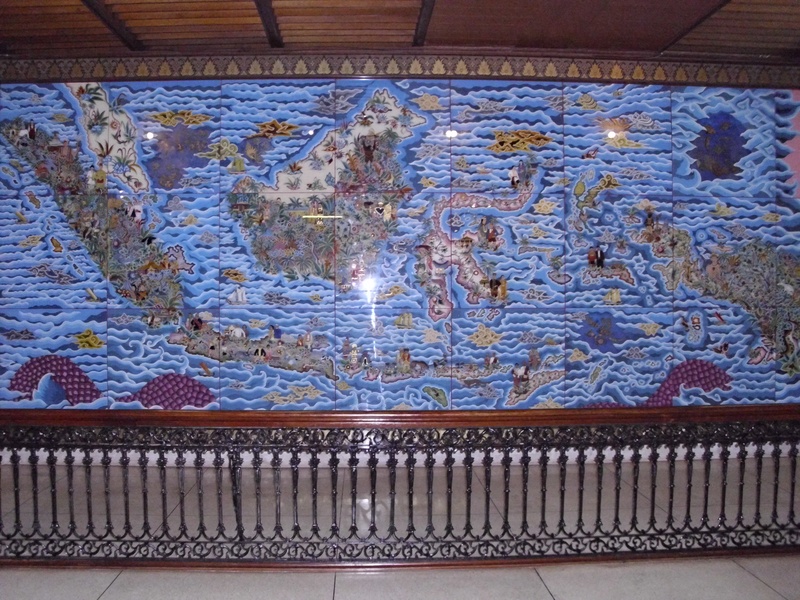
The first floor showroom theme Unity in Diversity (It varies, but one also). This section presents the traditional dress and wedding dress from 27 provinces in Indonesia (the Indonesian province from 1975 to 2000). This showroom also displays a variety of art unique to Indonesia, such as a wide range of dance, wayang and gamelan, as well as glass painting pictorial map of Indonesia. The exhibition showcases the cultural richness and diversity of Indonesia, which consists of a variety of languages, traditions, religions, cultures, and customs of the people of Indonesia. 


Second Floor
Humans and the Environment is the theme of the second-floor showroom. Aims to explain the interaction of nature and people of Indonesia with its environment. Exhibited a variety of miniature houses traditional houses, buildings of worship, granary, and the layout of buildings and living space of Indonesian society. For example, houses on stilts, houses built on trees or on the river, as well as trending and other traditional buildings.Dioramas of the traditional Indonesian houses are also on display, such as custom bridal chamber Palembang, Java community living room, and kitchen Batak society. Also exhibited a variety of everyday objects for the purposes of hunting, gathering food, and agricultural tools. Some dioramas featuring traditional ceremonies concerning the human life cycle, such as ceremonies Mitoni (nujuh monthly), the Land of Snow (ceremony for the baby), circumcision, Mapedes (Balinese tooth filing ceremony), Datuk inauguration ceremony, and Pelaminan Minangkabau. 


Third Floor 
Art and Craft is the theme of the third floor showroom. This room shows art and traditional crafts and contemporary Indonesian society. Traditional handicrafts such as songket fabric, Weaving and Batik on display, as well as craft objects from metals such as copper and brass engraving.Wood carving is very thorough and complex also displayed, such as the carving of Jepara (Central Java), Bali, Toraja, and Asmat. The main art on the third floor is a huge wooden carving shaped Kalpataru, the tree of life. Carving a tree as high as eight meters wide and four feet symbolizes the universe and contains five basic elements: sky, water, wind, earth and fire. This is a major art exhibition in the museum closes.

KOMODO ISLAND

Komodo Island is an island located in the Nusa Tenggara islands. Komodo Island is known as a habitat for native animals Komodo dragons. The island is also the Komodo National Park is managed by the Central Government. Komodo Island is located east of the island of Sumbawa, separated by Sape Strait.

Administratively, this island including the District of Komodo, West Manggarai, East Nusa Tenggara Province, Indonesia. Komodo Island is the westernmost tip of East Nusa Tenggara Province, bordering the province of West Nusa Tenggara.


On the island of Komodo, dragons animals live and breed well. Until August 2009, on this island there are an estimated 1300 dragons head. Coupled with the other islands, such as the island of Rinca and Gili and Motang, their number totaled about 2500 birds. There are approximately 100 individuals dragons in Wae Wuul Nature Reserve on the mainland island of Flores, but not including the Komodo National Park.


In addition to the Komodo dragon, the island also holds a variety of exotic flora Sepang wood by local people used as a medicinal and dye clothing, tree or Sterculia oblongata nitak is believed to be useful as medicines and seeds are tasty and delicious like peas.


Selasa, 31 Januari 2012

Trowulan Museum

Indonesia Tourism
One of Trowulan's central attractions is the new Archaeological Museum, to be found on the western side of the kolam segaran. Officially opened in 1987, it was built for the purpose of displaying and preserving the ever increasing number of historical treasures discovered in the vicinity of the old Majapahit capital. Covering a spacious area of some 57,625 square metres, this new site accommodates the collection of the old Trowulan Museum, as well as the bulk of the stone sculpture which used to be housed in the museum of Mojokerto. Among the objects on display, a few deserve special mention, notably the famous portrait statue of Airlangga as Wishnu on Garuda, from Candi Belahan; a winged figure which is said to portray the legendary king of Blambangan, Menak Jinggo; and a part of a temple from Ampelgading, Malang, displaying the story of Samodramanthana in finely carved relief..
sources: http://www.eastjava.com/books/majapahit/html/museum.html
 

Indonesia Tourism Copyright © 2012 Fast Loading -- Powered by Blogger